Senetimental Echo in Blowing Through My Life Again
| "Helter Skelter" | |
|---|---|
 Movie sleeve for the 1996 limited jukebox-only unmarried re-release (reverse) | |
| Song past the Beatles | |
| from the anthology The Beatles | |
| Released | 22 Nov 1968 |
| Recorded | 18 July, 9–10 September 1968 |
| Studio | EMI, London |
| Genre |
|
| Length |
|
| Label | Apple |
| Songwriter(s) | Lennon–McCartney |
| Producer(s) | George Martin |
"Helter Skelter" is a song by the English rock band the Beatles from their 1968 album The Beatles (likewise known every bit "the White Album"). It was written by Paul McCartney and credited to Lennon–McCartney. The vocal was McCartney'south endeavor to create a sound as loud and dirty as possible. Information technology is regarded as a key influence in the early development of heavy metal. In 1976, the song was released as the B-side of "Got to Get Yous into My Life" in the United States, to promote the Capitol Records compilation Rock 'n' Whorl Music.
Along with other tracks from the White Album, "Helter Skelter" was interpreted by cult leader Charles Manson as a message predicting inter-racial state of war in the Usa. Manson titled his vision of this insurgence after the song. Rolling Stone mag ranked "Helter Skelter" 52nd on its list of "The 100 Greatest Beatles Songs". Siouxsie and the Banshees, Mötley Crüe, Aerosmith, U2, Oasis and Pat Benatar are amid the artists who have covered the rail, and McCartney has ofttimes performed it in concert.
Background and inspiration [edit]

Paul McCartney was inspired to write "Helter Skelter" after reading an interview with the Who's Pete Townshend where he described their September 1967 single, "I Can Encounter for Miles", as the loudest, rawest, dirtiest song the Who had e'er recorded. He said he and then wrote "Helter Skelter" "to exist the about raucous vocal, the loudest drums, et cetera".[five] On 20 November 1968, ii days before the release of The Beatles (besides known as "the White Album"),[6] McCartney gave Radio Luxembourg an sectional interview, in which he commented on several of the anthology's songs.[7] Speaking of "Helter Skelter", he said:
Umm, that came about just 'cause I'd read a review of a record which said, "and this group really got us wild, there's echo on everything, they're screaming their heads off." And I only remember thinking, "Oh, it'd be great to exercise one. Pity they've done it. Must exist neat – really screaming record." And then I heard their record and it was quite straight, and it was very sort of sophisticated. It wasn't rough and screaming and tape echo at all. And then I thought, "Oh well, we'll do i like that, then." And I had this song chosen "Helter Skelter," which is merely a ridiculous vocal. So we did it like that, 'cos I like noise.[8]
In British English, a helter skelter is a fairground attraction consisting of a tall spiral slide winding round a tower, but the phrase tin can too hateful chaos and disorder.[nine] McCartney said that he was "using the symbol of a helter skelter as a ride from the top to the bottom; the rise and fall of the Roman Empire – and this was the fall, the demise."[5] He later said that the song was a response to critics who defendant him of writing only sentimental ballads and beingness "the soppy one" of the band.[x] Although the vocal is credited to the Lennon–McCartney partnership, it was written by McCartney alone.[xi] John Lennon acknowledged in a 1980 interview: "That's Paul completely."[12]
Limerick [edit]
The song is in the key of E major[13] and in a 4/iv fourth dimension signature.[xiv] On the recording issued on The Beatles, its construction comprises two combinations of verse and chorus, followed by an instrumental passage and a third verse–chorus combination. This is followed by a prolonged ending during which the performance stops, picks up once again, fades out, fades dorsum in, and then fades out one final fourth dimension amongst a cacophony of sounds.[xiv] The stereo mix features i more than department that fades in and concludes the song.[15]
The only chords used in the song are E7, Grand and A, with the offset of these being played throughout the extended catastrophe. Musicologist Walter Everett comments on the musical course: "There is no dominant and little tonal office; organized racket is the brief."[16] The lyrics initially follow the title'due south fairground theme, from the opening line "When I get to the bottom I get dorsum to the top of the slide". McCartney completes the first one-half-poetry with a hollered "and then I run into y'all Again!"[17] The lyrics so become more than suggestive and provocative, with the vocalizer request, "Only do you, don't yous, want me to love you?"[18] In writer Jonathan Gould's clarification, "The song turns the colloquialism for a fairground ride into a metaphor for the sort of frenzied, operatic sex that adolescent boys of all ages like to fantasize about."[19]
Recording [edit]
"Helter Skelter" was recorded several times during the sessions for the White Anthology. During the xviii July 1968 session, the Beatles recorded take 3 of the song, lasting 27 minutes and 11 seconds,[20] although this version is slower, differing greatly from the album version.[21] [nb i] Chris Thomas produced the ix September session in George Martin's absence.[two] He recalled the session was especially spirited: "While Paul was doing his vocal, George Harrison had gear up fire to an ashtray and was running effectually the studio with information technology above his head, doing an Arthur Brown."[22] [nb 2] Ringo Starr recalled: "'Helter Skelter' was a track we did in total madness and hysterics in the studio. Sometimes you just had to shake out the jams."[24]
On 9 September, 18 takes lasting approximately v minutes each were recorded, with the last one featured on the original LP.[22] At effectually iii:40, the song completely fades out, then gradually fades dorsum in, fades dorsum out partially, and finally fades dorsum in quickly with 3 cymbal crashes and shouting from Starr.[25] During the end of the 18th take, he threw his drum sticks across the studio[15] and screamed, "I got blisters on my fingers!"[5] [22] [nb iii] Starr's shout was only included on the stereo mix of the vocal; the mono version (originally on LP only) ends on the beginning fadeout without Starr'due south outburst.[27] [nb 4] On ten September, the ring added overdubs which included a lead guitar role by Harrison, trumpet played by Mal Evans, piano, further drums, and "oral fissure sax" created by Lennon blowing through a saxophone mouthpiece.[27]
According to music critic Tim Riley, although McCartney and Lennon had diverged markedly as songwriters during this flow, the completed track tin can exist seen every bit a "competitive apposition" to Lennon's "Everybody'southward Got Something to Hide Except Me and My Monkey". He says that whereas Lennon "submerges in scatalogical contradictions" in his song, "Helter Skelter" "ignites a scathing, almost vehement disorder".[29] In Everett's view, rather than the Who's contemporaneous music, the song "sounds more like an answer to [Yoko Ono]", the Japanese performance creative person who, every bit Lennon's new romantic partner, was a abiding presence at the White Album sessions and a source of tension inside the ring.[thirty]
Release and reception [edit]
"Helter Skelter" was sequenced every bit the penultimate runway on side three of The Beatles, betwixt "Sexy Sadie" and "Long, Long, Long".[31] [32] The segue from "Sexy Sadie" was a rare case of a gap (or "rill") being used to split the album's tracks, and the brief silence served to enhance the song'south abrupt arrival.[33] In Riley's clarification, the opening guitar figure "demolishes the silence ... from a high, piercing vantage point" while, at the finish of "Helter Skelter", the meditative "Long, Long, Long" begins as "the smoke and ash are still settling".[34] The double LP was released by Apple Records on 22 Nov 1968.[six] [35]
In his contemporary review for International Times, Barry Miles described "Helter Skelter" as "probably the heaviest rocker on plastic today",[36] while the NME 'due south Alan Smith found it "depression on melody but high on atmosphere" and "frenetically sexual", adding that its stride was "so fast they all only just about keep upwards with themselves".[37] Record Mirror 's reviewer said the track contained "screaming pained vocals, ear splitting buzz guitar and general instrumental defoliation, just [a] rather typical pattern", and concluded: "Ends sounding like five thousand large electric flies out for a skillful time. John [sic] then blurts out with excruciating torment: 'I got blisters on my fingers!'"[38]
In his review for Rolling Rock, Jann Wenner wrote that the Beatles had been unfairly overlooked as hard stone stylists, and he grouped the song with "Birthday" and "Everybody's Got Something to Hide Except Me and My Monkey" as White Anthology tracks that captured "the very best traditional and contemporary elements in stone and roll". He described "Helter Skelter" as "excellent", highlighting its "guitar lines behind the title words, the rhythm guitar track layering the whole song with that precisely used fuzztone, and Paul's gorgeous song".[39] Geoffrey Cannon of The Guardian praised it every bit one of McCartney's "perfect, professional person songs, packed with verbal quotes and characterisation", and recommended the stereo version for the mode information technology "transforms" the song "from a not bad fast number to one of my best thirty tracks of all time".[40] Although he misidentified it as a Lennon vocal, William Mann of The Times said "Helter Skelter" was "exhaustingly marvellous, a revival that is willed past creativity ... into resurrection, a physical but essentially musical thrust into the loins".[41]
In June 1976, Capitol Records included the track on its themed double anthology compilation Rock 'n' Roll Music. In the United states of america, the song was also issued on the single promoting the album, as the B-side to "Got to Get You into My Life".[42] In 2012, "Helter Skelter" appeared on the iTunes compilation album Tomorrow Never Knows, which the band'due south website described every bit a collection of "the Beatles' most influential stone songs".[43]
Charles Manson interpretation [edit]
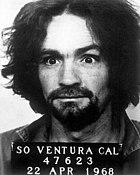
Charles Manson told his followers that several White Album songs, particularly "Helter Skelter",[44] were part of the Beatles' coded prophecy of an apocalyptic war in which racist and non-racist whites would be manoeuvred into virtually exterminating each other over the treatment of blacks.[45] [46] [47] Upon the war'due south conclusion, afterward black militants had killed off the few whites that had survived, Manson and his "Family unit" of followers would emerge from an surreptitious city in which they would have escaped the conflict. As the just remaining whites, they would rule blacks, who, every bit the vision went, would exist incapable of running the The states.[48] Manson employed "Helter Skelter" every bit the term for this sequence of events.[49] [50] In his interpretation, the lyrics of the Beatles' "Helter Skelter" described the moment when he and the Family would emerge from their hiding place – a disused mine shaft in the desert exterior Los Angeles.[51]
Los Angeles Deputy District Attorney Vincent Bugliosi, who led the prosecution of Manson and 4 of his followers who acted on Manson's education in the Tate-LaBianca murders, named his all-time-selling book nearly the murders Helter Skelter.[52] At the scene of the LaBianca murders in August 1969, the phrase (misspelt as "HEALTER SKELTER") was plant written in the victims' blood on the fridge door.[53] [54] In Oct 1970, Manson'southward defence force squad announced that they would call on Lennon for his testimony. Lennon responded that his comments would be of no utilize, since he had no manus in writing "Helter Skelter".[55]
Bugliosi's book was the ground for the 1976 television moving picture Helter Skelter. The film'southward popularity in the Us ensured that the vocal, and the White Anthology generally, received a new moving ridge of attending. Equally a result, Capitol planned to effect "Helter Skelter" every bit the A-side of the single from Rock 'n' Roll Music but relented, realising that to exploit its association with Manson would be in poor gustatory modality.[42] In the final interview he gave before his murder in December 1980, Lennon dismissed Manson every bit "merely an farthermost version" of the type of listener who read fake messages in the Beatles' lyrics, such as those behind the 1969 "Paul is dead" rumour.[56] Lennon also said: "All that Manson stuff was congenital effectually George's song nigh pigs ['Piggies'] and this 1, Paul's song about an English fairground. It has nothing to practise with anything, and least of all to exercise with me."[12]
Reflecting on "Helter Skelter" and its appropriation by the Manson Family unit in his 1997 authorised biography, Many Years from Now, McCartney said, "Unfortunately, it inspired people to practise evil deeds" and that the song had acquired "all sorts of ominous overtones because Manson picked it up every bit an anthem".[57] Author Devin McKinney describes the White Album as "also a blackness album" in that it is "haunted by race".[58] He writes that, in spite of McCartney'due south comments nigh the song'due south meaning, the recording conveys a violent subtext typical of much of the album and that "Here as ever in Beatle music, functioning determines meaning; and equally the adrenalized guitars run riot, the significant is elementary, dreadful, inarticulate, and instantly understood: She's coming downwardly fast."[one] In her 1979 collection of essays about the 1960s, titled The White Album, Joan Didion wrote that many people in Los Angeles cite the moment that news arrived of the Manson Family unit's killing spree in August 1969 as having marked the end of the decade.[59] According to author Doyle Greene, the Beatles' "Helter Skelter" effectively captured the "crises of 1968", which contrasted sharply with the previous year's Summer of Love ethos. He adds: "While 'Revolution' posited a forthcoming unity equally far every bit social change, 'Helter Skelter' signified a chaotic and overwhelming sense of falling apart occurring throughout the world politically and, non unrelated, the falling autonomously of the Beatles as a working band and the counterculture dream they represented."[60]
This theory was introduced past Bugliosi in Manson's trial. Mike McGann, the lead police investigator on the Tate-LaBianca murders stated, "Everything in Vince Bugliosi'due south book (Helter Skelter) is wrong. I was the lead investigator on the example. Bugliosi didn't solve it. Nobody trusted him." Police detective Charlie Guenther who investigated the murders and Bugliosi'southward co-prosecutor Aaron Stovits have as well discredited this equally the motive for the murders.[61]
Retrospective reviews and legacy [edit]
Writing for MusicHound in 1999, Guitar Earth editor Christopher Scapelliti grouped "Helter Skelter" with "While My Guitar Gently Weeps" and "Happiness Is a Warm Gun" as the White Album's iii "fascinating standouts".[62] The vocal was noted for its "proto-metal roar" past AllMusic reviewer Stephen Thomas Erlewine.[63] Congruent with the 50th ceremony of the album's release, Jacob Stolworthy of The Independent listed the aforementioned three songs as its best tracks, with "Helter Skelter" ranked at number three. Stolworthy described it as "i of the best stone songs e'er recorded" and ended: "The fiercest, nigh blistering runway that arguably paved the way for heavy metallic is far removed from the tame love songs people were used to from [McCartney]."[64] Writing in 2014, Ian Fortnam of Classic Rock mag cited "Helter Skelter" as ane of the four songs that fabricated the Beatles' White Album an "indelible pattern for stone", along with "While My Guitar Gently Weeps", "Yer Blues" and "Don't Pass Me By", in that together they contained "every ane of rock'south key ingredients".[65] In the case of McCartney's song, he said that the track was "i of the prime progenitors of heavy metal" and a major influence on 1970s punk rock.[66]
Ian MacDonald dismissed "Helter Skelter" as "ridiculous, [with] McCartney shrieking weedily against a massively tape-echoed backdrop of out-of-tune thrashing", and said that in their efforts to embrace heavy rock, the Beatles "comically overreached themselves, reproducing the requisite bulldozer design but on a Dinky Toy calibration". He added: "Few accept seen fit to describe this rail as anything other than a literally drunken mess."[67] Rob Sheffield was also unimpressed, writing in The Rolling Rock Album Guide (2004) that, post-obit the double album's release on CD, "now you can plan 'Sexy Sadie' and 'Long, Long, Long' without having to elevator the needle to skip over 'Helter Skelter.'"[68] David Quantick, in his book Revolution: The Making of the Beatles' White Anthology, describes the song as "Neither loud enough to bludgeon the listener into existence impressed nor inspired enough to be heady". He says that it becomes "a bit dull after two minutes" and, after its laboured attempts at an catastrophe, is "redeemed only" by Starr's closing remark.[69]
Doyle Greene states that the Beatles and Manson are "permanently connected in pop-culture consciousness" as a result of Manson's estimation of "Helter Skelter", "Piggies" and other tracks from the White Album.[70] "Helter Skelter" was voted the quaternary worst song in one of the first polls to rank the Beatles' songs, conducted in 1971 past WPLJ and The Village Vox.[71] According to Walter Everett, information technology is typically among the five nigh-disliked Beatles songs for members of the baby boomer generation, who made up the ring's contemporary audition during the 1960s.[72]
In March 2005, Q magazine ranked "Helter Skelter" at number 5 in its list of the "100 Greatest Guitar Tracks Ever".[73] The song appeared at number 52 in Rolling Stone 's 2010 list of "The 100 Greatest Beatles Songs".[25] [74] In 2018, Kerrang! selected it as one of "The 50 Nearly Evil Songs Ever" due to its association with the Manson Family unit murders.[75]
Cover versions [edit]
Since the producers of the 1976 film Helter Skelter were denied permission to utilize the Beatles recording, the song was re-recorded for the soundtrack by the band Silverspoon.[76] In 1978, Siouxsie and the Banshees included a comprehend of "Helter Skelter", produced by Steve Lillywhite, on their debut album The Scream.[77] [78] Fortnam cites the band'southward choice as reflective of how the song'due south "macabre association with Charles Manson ... simply served to accentuate its enduring appeal in certain quarters".[79] [nb 5] While discussing the stereo and mono versions of the Beatles' 1968 recording and the all-time-known cover versions of the rail up to 2002, Quantick highlights the Siouxsie and the Banshees recording as "the all-time of all of them".[69] [nb six] In an article about the legacy of the song, Fiscal Times further commented the Banshees' version, saying: "The abrupt catastrophe on "stop" also leaves the listener mentally stuck at the top of the slide with no manner down".[81]
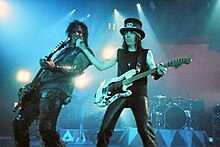
Nikki Sixx and Mick Mars of Mötley Crüe (pictured in June 2005). The song was highly influential in the emergence of heavy metallic.[76]
In 1983, Mötley Crüe included the song on their album Shout at the Devil. Nikki Sixx, the band's bassist, recalled that "Helter Skelter" appealed to them through its guitars and lyrics, but also because of the Manson murders and the vocal's standing equally a "existent symbol of darkness and evil".[82] Mötley Crüe's 1983 picture disc for the song featured a photo of a fridge with the title written in blood.[82] That aforementioned year, the Bobs released an a-cappella version on their album The Bobs.[83] Information technology earned them a 1984 Grammy nomination for Best Vocal Arrangement for 2 or More than Voices.[84]
In 1988, a U2 recording was used every bit the opening track on their anthology Rattle and Hum. The song was recorded live at the McNichols Sports Arena in Denver, Colorado on 8 Nov 1987.[85] Introducing the song, Bono said, "This is a vocal Charles Manson stole from the Beatles. Nosotros're stealing information technology back."[76] Aerosmith included a cover of "Helter Skelter", recorded in 1975, on their 1991 compilation Pandora'due south Box compilation.[86] Aerosmith's version charted at number 21 on the Album Rock Tracks chart in the US.[87]
Oasis recorded a encompass of "Helter Skelter", released in 2000 as a B-side on their "Who Feels Honey?" single. They besides performed the vocal on their world tour promoting their quaternary album Continuing on the Shoulder of Giants in the early 2000s. A live version was included on their live album Familiar to Millions.
"Helter Skelter" has been covered by many other artists, including Pat Benatar, Vow Wow, Hüsker Dü, Dianne Heatherington and Thrice.[88] Daze stone band Rob Zombie collaborated with Marilyn Manson on a encompass of "Helter Skelter", which was released in 2018 to promote their co-headlining "Twins of Evil: The 2d Coming Tour".[89] [90] Their version peaked at number ix on Billboard 'southward Hard Rock Digital Songs.[91]
McCartney alive performances [edit]
Since 2004, McCartney has frequently performed "Helter Skelter" in concert. The song featured in the gear up lists for his '04 Summer Tour, The 'Usa' Tour (2005), Summertime Live '09 (2009), the Good Evening Europe Tour (2009), the Up and Coming Tour (2010–eleven) and the On the Run Tour (2011–12).[76] He also played it on his Out There Tour, which began in May 2013. In the last tours, the vocal has been generally inserted on the third encore, which is the last time the band enters the stage. It is commonly the last but i vocal, performed subsequently "Yesterday" and before the final medley including "The End". McCartney played the vocal on his Ane on One Tour at Fenway Park on 17 July 2016 accompanied by the Grateful Dead'south Bob Weir and New England Patriots football actor Rob Gronkowski.
McCartney performed the song alive at the 48th Annual Grammy Awards on 8 February 2006 at the Staples Center in Los Angeles. In 2009, he performed it live on superlative of the Ed Sullivan Theater marquee during his appearance on the Late Show with David Letterman.[76]
At the 53rd Grammy Awards in 2011, the version of the song from McCartney's live anthology Expert Evening New York City, recorded during the Summer Live '09 tour, won in the category of All-time Solo Rock Vocal Performance.[92] [93] It was his first solo Grammy Award since he won for arranging "Uncle Albert/Admiral Halsey" in 1972.[94] McCartney opened his set at 12-12-12: The Concert for Sandy Relief with the vocal.[95] On 13 July 2019, the final date of his Freshen Up tour,[96] McCartney performed "Helter Skelter" at Dodger Stadium in Los Angeles with Starr playing drums.[97]
Personnel [edit]
According to Mark Lewisohn[22] and Walter Everett:[98]
- Paul McCartney – atomic number 82 vocal, bankroll vocal, atomic number 82/rhythm guitar
- John Lennon – backing song, half-dozen-string bass, sound effects (through tenor saxophone mouthpiece), piano[99]
- George Harrison – backing vocal, lead/rhythm guitar, slide guitar
- Ringo Starr – drums, vocal shout
- Mal Evans – trumpet
Notes [edit]
- ^ Take ii, recorded the same solar day, originally 12 minutes and 54 seconds long, was edited downward to iv:35 for Anthology iii.[21]
- ^ Harrison's antics were in reference to Brown's contemporary hitting song "Fire".[23]
- ^ Some sources erroneously credit the "blisters" line to Lennon;[25] in fact, Lennon can be heard asking "How'due south that?" before Starr's outburst.[26]
- ^ This version was not initially bachelor in the United States as mono albums had already been phased out there.[28] The mono version was later released on the American version of the Rarities album.[27] In 2009, information technology was fabricated available on the CD mono reissue of The Beatles every bit function of the Beatles in Mono box set.
- ^ He likewise comments on the significance of Chris Thomas having become "i of punk's leading sonic architects" by the tardily 1970s, with his production of the Sex activity Pistols' Never Mind the Bollocks.[79]
- ^ Matt Harvey of BBC Music describes the Banshees' hit recording of the White Anthology track "Dear Prudence" equally "surprisingly tiresome" but admires their version of "Helter Skelter" as a "magnificent deconstruction" and "i of the greatest covers of all time".[lxxx]
References [edit]
- ^ a b McKinney 2003, p. 231.
- ^ a b Winn 2009, p. 210.
- ^ Riley 2002, p. 24.
- ^ Athitakis, Marker (September–October 2013). "A Beatles Reflection". Humanities. National Endowment of the Humanities. Retrieved 24 April 2016.
- ^ a b c Miles 1997, pp. 487–88.
- ^ a b Miles 2001, p. 314.
- ^ Winn 2009, p. 224.
- ^ "Radio Grand duchy of luxembourg interview, Paul McCartney (20 November 1968)". Beatles Interview Database. Retrieved half-dozen Dec 2009.
- ^ "Definition of helter-skelter". AskOxford. Retrieved nineteen September 2010.
- ^ The Beatles 2000, pp. 310–11.
- ^ Womack 2014, pp. 381–82.
- ^ a b Sheff 2000, p. 200.
- ^ MacDonald 2007, p. 495.
- ^ a b Pollack, Alan W. (7 June 1998). "Notes on 'Helter Skelter'". Soundscapes. Retrieved 3 Apr 2019.
- ^ a b Spitz 2005, p. 794.
- ^ Everett 1999, p. 191.
- ^ Riley 2002, p. 281.
- ^ O'Toole, Kit (25 July 2018). "The Beatles, 'Helter Skelter' from The White Album (1968): Deep Beatles". Something Else!. Retrieved 4 April 2019.
- ^ Gould 2007, p. 520.
- ^ Lewisohn 2005, p. 143.
- ^ a b Winn 2009, p. 190.
- ^ a b c d Lewisohn 2005, p. 154.
- ^ Quantick 2002, p. 139.
- ^ The Beatles 2000, p. 311.
- ^ a b c Womack 2014, p. 382.
- ^ Winn 2009, pp. 210–11.
- ^ a b c Winn 2009, p. 211.
- ^ Miles 2001, p. 321.
- ^ Riley 2002, p. 261.
- ^ Everett 1999, pp. 165, 347.
- ^ Miles 2001, p. 319.
- ^ Everett 1999, p. 164.
- ^ McKinney 2003, p. 238.
- ^ Riley 2002, pp. 281, 282.
- ^ Lewisohn 2005, p. 163.
- ^ Miles, Barry (29 November 1968). "Multi-Purpose Beatles Music". International Times. p. 10.
- ^ Smith, Alan (ix Nov 1968). "Beatles Double-LP in Full". NME. p. 5.
- ^ Uncredited writer (16 November 1968). "The Beatles: The Beatles (White Anthology) (Apple)". Record Mirror. Available at Rock'south Backpages (subscription required).
- ^ Wenner, Jann Southward. (21 December 1968). "Review: The Beatles' 'White Anthology'". Rolling Stone. p. ten. Retrieved 26 June 2019.
- ^ Cannon, Geoffrey (26 November 1968). "Back to Spring: The Beatles: The Beatles (White Album) (Apple)". The Guardian. Available at Rock'southward Backpages (subscription required).
- ^ Mann, William (22 November 1968). "The New Beatles Album". The Times.
- ^ a b Schaffner 1978, p. 187.
- ^ Womack 2014, p. 918.
- ^ Doggett 2007, p. 394.
- ^ Bugliosi 1997, pp. 240–247. sfn fault: no target: CITEREFBugliosi1997 (assist)
- ^ Linder, Douglas (2007). "Testimony of Paul Watkins in the Charles Manson Trial". The Trial of Charles Manson. University of Missouri-Kansas City School of Law. Archived from the original on 20 March 2007. Retrieved 28 February 2007.
- ^ Linder, Douglas (2007). "The Influence of the Beatles on Charles Manson". The Trial of Charles Manson. University of Missouri-Kansas City Schoolhouse of Law. Archived from the original on 21 December 2002. Retrieved 28 February 2007.
- ^ Doggett 2007, pp. 305–06.
- ^ Lachman 2001, p. 262.
- ^ Quantick 2002, pp. 190–91.
- ^ Miles 1997, pp. 489–90.
- ^ Lachman 2001, p. 276.
- ^ Lachman 2001, pp. 2–iii.
- ^ Paytress, Marker (2003). "Family Misfortunes". Mojo Special Limited Edition: 1000 Days of Revolution (The Beatles' Final Years – Jan i, 1968 to Sept 27, 1970). London: Emap. p. 106.
- ^ Doggett 2007, pp. 393–94.
- ^ Sheff 2000, p. 88.
- ^ Miles 1997, p. 488.
- ^ McKinney 2003, p. 232.
- ^ Gould 2007, pp. 509–ten, 595.
- ^ Greene 2016, pp. 51–52.
- ^ O'Neill, Tom (2019). Anarchy: Charles Manson, the CIA, and the Secret History of the Sixties. Picayune, Brown. pp. 104, 149, 151–152. ISBN978-0-316-47757-4. Archived from the original on 6 June 2021. Retrieved xviii July 2021.
- ^ Graff & Durchholz 1999, p. 88.
- ^ Erlewine, Stephen Thomas. "The Beatles The Beatles [White Album]". AllMusic . Retrieved 3 April 2019.
- ^ Stolworthy, Jacob (22 November 2018). "The Beatles' White Album tracks, ranked – from Blackbird to While My Guitar Gently Weeps". The Independent . Retrieved 27 March 2019.
- ^ Fortnam 2014, pp. 42–43.
- ^ Fortnam 2014, pp. 43–44.
- ^ MacDonald 2007, p. 298.
- ^ Brackett & Hoard 2004, p. 53.
- ^ a b Quantick 2002, p. 138.
- ^ Greene 2016, p. 197.
- ^ Schaffner 1978, p. 217.
- ^ Everett 1999, p. 279.
- ^ UG Team (21 March 2005). "Greatest Guitar Tracks". Ultimate Guitar . Retrieved 1 April 2019.
- ^ "100 Greatest Beatles Songs". rollingstone.com. 19 September 2011. Retrieved 15 Oct 2014.
- ^ Kerrang! staff (28 September 2018). "The 50 Most Evil Songs Ever". Kerrang! . Retrieved 20 July 2019.
- ^ a b c d e Womack 2014, p. 383.
- ^ Clark, Carol (15 Feb 2018). "The story behind the song: Dear Prudence by Siouxsie and the Banshees". Louder Sound . Retrieved 12 March 2019.
- ^ Johnston, Chris. "The Crate: Siouxsie and the Banshees faithfully encompass the Beatles' Dear Prudence". The Sydney Morning Herald . Retrieved 12 March 2019.
- ^ a b Fortnam 2014, p. 44.
- ^ Harvey, Matt (2002). "Siouxsie and The Banshees The All-time of Siouxsie and the Banshees Review". BBC Music. Retrieved 2 Baronial 2019.
- ^ Fildes, Nic (3 May 2021). "Helter Skelter — The Beatles' cruel song that inspired a murder spree". Financial Times. Archived from the original on 13 May 2021. Retrieved 11 May 2021.
- ^ a b Fortnam 2014, p. 41.
- ^ "The Bobs – The Bobs". AllMusic . Retrieved 7 September 2017.
- ^ 1984 Grammy honour nomination, Best Vocal Arrangement for Two or More Voices, Richard Greene, Gunnar Madsen – Helter Skelter (The Bobs) LA Times, "The Envelope" awards database, accessed 2010 January 13.
- ^ "U2 – Helter Skelter". U2songs.com. Retrieved 20 November 2017.
- ^ "Pandora's Box – Aerosmith". AllMusic . Retrieved vii September 2017.
- ^ Colombo, Anthony (xvi Nov 1991). "Anthology Rock Tracks". Billboard. p. xvi.
- ^ Fontenot, Robert. "The Beatles Songs: 'Helter Skelter' – The history of this classic Beatles song". oldies.about.com. Archived from the original on 6 September 2015. Retrieved 4 April 2019.
- ^ Bienstock, Richard (eleven July 2018). "Hear Marilyn Manson, Rob Zombie Cover Beatles' 'Helter Skelter'". Rolling Stone. Wenner Media. Archived from the original on 15 March 2019. Retrieved viii August 2018.
- ^ Kaufman, Spencer (eleven July 2018). "Rob Zombie and Marilyn Manson squad upward for comprehend of The Beatles' "Helter Skelter": Stream". Consequence of Audio . Retrieved 8 Baronial 2018.
- ^ "Marilyn Manson - Chart History (Hard Rock Digital Songs)". Billboard . Retrieved 4 September 2020.
- ^ Womack 2014, pp. 331–32.
- ^ Last Nominations List, 53rd Grammy Awards Archived 14 December 2010 at the Wayback Auto, National Academy of Recording Arts and Sciences. Retrieved on 10 February 2011.
- ^ [1] [ permanent dead link ] Yahoo! Entertainment Story – Reuters. Retrieved on 13 February 2011. [ dead link ]
- ^ '12-12-12': Paul McCartney fronts Nirvana 'reunion' and more highlights from Sandy benefit concert Archived 14 December 2012 at the Wayback Machine. Retrieved xiii December 2012.
- ^ Larsen, Peter (14 July 2019). "Paul McCartney reunites with Ringo Starr at Dodger Stadium during career-spanning show". dailynews.com. Retrieved 17 July 2019.
- ^ Hobbs, Thomas (14 July 2019). "With a little aid from my friends: Scout Paul McCartney bring out Ringo Starr for the final night of his United states of america bout". nme.com . Retrieved 17 July 2019.
- ^ Everett 1999, pp. 191, 347.
- ^ Howlett, Kevin (2018). The Beatles (50th Ceremony Super Deluxe Version) (book). Apple Records.
Sources [edit]
- The Beatles (2000). The Beatles Anthology . San Francisco, CA: Chronicle Books. ISBN0-8118-2684-8.
- Brackett, Nathan; Hoard, Christian, eds. (2004). The New Rolling Stone Album Guide (4th ed.). New York, NY: Fireside/Simon & Schuster. ISBN0-7432-0169-8.
- Bugliosi, Vincent; Gentry, Burt (1994). Helter Skelter: The Truthful Story of the Manson Murders (25th Ceremony ed.). New York, NY: W.Due west. Norton & Company. ISBN0-393-08700-X.
- Doggett, Peter (2007). At that place'due south a Anarchism Going On: Revolutionaries, Stone Stars, and the Ascension and Fall of '60s Counter-Culture . Edinburgh, Uk: Canongate Books. ISBN978-1-84195-940-v.
- Everett, Walter (1999). The Beatles as Musicians: Revolver Through the Anthology. New York, NY: Oxford Academy Press. ISBN978-0-nineteen-512941-0.
- Fortnam, Ian (Oct 2014). "You Say You Want a Revolution ...". Classic Stone. pp. 33–46.
- Gould, Jonathan (2007). Can't Buy Me Dear: The Beatles, U.k. and America. London: Piatkus. ISBN978-0-7499-2988-half dozen.
- Graff, Gary; Durchholz, Daniel, eds. (1999). MusicHound Stone: The Essential Album Guide. Farmington Hills, MI: Visible Ink Press. ISBN1-57859-061-two.
- Greene, Doyle (2016). Rock, Counterculture and the Avant-Garde, 1966–1970: How the Beatles, Frank Zappa and the Velvet Hush-hush Defined an Era. Jefferson, NC: McFarland. ISBN978-1-4766-6214-5.
- Hertsgaard, Mark (1996). A Day in the Life: The Music and Artistry of the Beatles. London: Pan Books. ISBN0-330-33891-9.
- Lachman, Gary (2001). Turn Off Your Mind: The Mystic Sixties and the Dark Side of the Age of Aquarius. New York, NY: The Disinformation Visitor. ISBN0-9713942-3-vii.
- Lewisohn, Marker (2005) [1988]. The Complete Beatles Recording Sessions: The Official Story of the Abbey Road Years 1962–1970. London: Bounty Books. ISBN978-0-7537-2545-0.
- MacDonald, Ian (2007). Revolution in the Caput: The Beatles' Records and the Sixties . Chicago, IL: Chicago Review Press. ISBN978-one-55652-733-iii.
- McKinney, Devin (2003). Magic Circles: The Beatles in Dream and History. Cambridge, MA: Harvard University Press. ISBN0-674-01202-X.
- Miles, Barry (1997). Paul McCartney: Many Years from At present. New York, NY: Henry Holt & Company. ISBN0-8050-5249-half dozen.
- Miles, Barry (2001). The Beatles Diary Volume 1: The Beatles Years. London: Omnibus Printing. ISBN0-7119-8308-9.
- Quantick, David (2002). Revolution: The Making of the Beatles' White Album. Chicago, IL: A Cappella Books. ISBN1-55652-470-half dozen.
- Riley, Tim (2002) [1988]. Tell Me Why – The Beatles: Album by Album, Vocal by Song, the Sixties and Afterward. Cambridge, MA: Da Capo Press. ISBN978-0-306-81120-3.
- Schaffner, Nicholas (1978). The Beatles Forever. New York, NY: McGraw-Colina. ISBN0-07-055087-5.
- Sheff, David (2000) [1981]. All We Are Saying: The Final Major Interview with John Lennon and Yoko Ono. New York, NY: St. Martin'south Press. ISBN0-312-25464-4.
- Sounes, Howard (2010). Fab: An Intimate Life of Paul McCartney. London: HarperCollins. ISBN978-0-00-723705-0.
- Spitz, Bob (2005). The Beatles: The Biography . Boston, MA: Little, Brownish. ISBN0-316-80352-9.
- Winn, John C. (2009). That Magic Feeling: The Beatles' Recorded Legacy, Volume Two, 1966–1970. New York, NY: Three Rivers Printing. ISBN978-0-307-45239-ix.
- Womack, Kenneth (2014). The Beatles Encyclopedia: Everything Fab Four. Santa Barbara, CA: ABC-CLIO. ISBN978-0-313-39171-2.
External links [edit]
- Full lyrics for the song at the Beatles' official website
slaughterwilloused.blogspot.com
Source: https://en.wikipedia.org/wiki/Helter_Skelter_%28song%29

Post a Comment for "Senetimental Echo in Blowing Through My Life Again"